High-level
Gigabit with 10GbE Networking for Advanced Small Businesses.
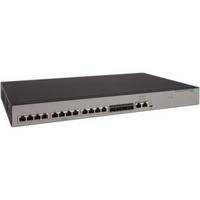
Each model of the HPE 1950
Switch Series includes four 10GbE connections to connect to
servers, network storage devices, or to other switches.
Two connections of 10GBASE-T
deliver 10GbE over copper Category 6a cabling for simple,
affordable, high-bandwidth connections to a maximum distance
of 100 meters.
Two SFP+ ports allow for
fiber connectivity at various distances, at 1/10GbE speeds,
using optional SFP+ 10GbE or SFP Gigabit transceivers.
Aggregate 10GbE connections
for even higher bandwidth using Link Aggregation Control
Protocol.
Simplified
Network Administration
Logically group or
"stack" as many as four units of the HPE 1950
Switch Series and manage this as a single entity, greatly
simplifying network administration. Interconnect stacked
units using 10GbE connections, with as much as 40GbE total
stacking bandwidth connecting the units.
Use the intuitive web-browser
based interface to configure and administer these
smart-managed devices.
These devices support SNMP
versions 1, 2c and 3, allowing administration of these
devices from a remote SNMP-based management platform.
Network Time Protocol
facilitates timekeeping across your network so time-based
actions and trouble-shooting logs are kept synchronized.
Units will automatically
retrieve an IP Address from a DHCP server, allowing for near
plug-and-play deployments.
Robust
Security to Protect Your Network
The HPE 1950 Switch Series
lets you use Virtual LANs and access control lists to set
bounds on what data can be seen by which users.
Leverage 802.1X with a RADIUS
server to ensure only known and authorized users can access
your network.
Multiple features guard your
network from user or server spoofing and from malicious
network-based attacks.
Help secure management
traffic using supported SSL/HTTPS encryption and SNMPv3
capabilities.
Resiliency
Features to Keep Your Network Running
The HPE 1950 Switch Series
supports Spanning Tree Protocol, Rapid Spanning Tree
Protocol, and Multiple Spanning Tree Protocol standards for
creating hot-standby recovery links.
Distribute important links
across multiple units in a logical stack for added
resiliency. Units can even be in different buildings and
still be logically stacked.
Devices support two
independent primary and secondary operating system flash
images for backup and recovery during unit upgrades.
Power over Ethernet (PoE)
models can be paired with an optional Redundant Power System
which can maintain power even if the unit's power supply
fails, as well as supplement available PoE power up to 780
Watts.
 Award One Technology
Pty Ltd